
In the audiovisual industry, selecting between an RFQ vs RFP can determine whether your AV project succeeds or struggles from the outset. The choice between a Request for Quotation (RFQ) and a Request for Proposal (RFP) directly impacts your project budget, implementation timeline, system quality, and vendor relationships. Simply put: use an RFQ when you have complete technical specifications and need competitive pricing; choose an RFP when you require design expertise, system architecture recommendations, and comprehensive solution development from qualified AV integrators.
Understanding the difference between RFQ vs RFP is essential for AV consultants, facility managers, and technology directors who must optimize procurement processes while managing stakeholder expectations. The wrong choice leads to project delays, budget overruns, inadequate system performance, or missed opportunities for innovation. With commercial AV installations becoming increasingly complex—integrating unified communications, digital signage, room automation, and smart building systems—your procurement strategy must align with both your technical readiness and strategic objectives.
Key Takeaways
✓ RFQs work when you have detailed equipment specifications and need competitive bidding on well-defined scope of work
✓ RFPs excel for complex projects requiring system design, technology consulting, and strategic recommendations
✓ The RFQ vs RFP decision hinges on your specification completeness, internal expertise, and project complexity
✓ Wrong procurement choices waste time, money, and limit access to vendor innovation and expertise
✓ Hybrid approaches combining both methods can optimize results for multi-phase AV installations
✓ AI-powered procurement tools are transforming how organizations evaluate and select AV service providers
✓ Proper documentation, clear evaluation criteria, and transparent processes benefit both clients and contractors
Understanding Core Procurement Documents in AV
Before diving into the RFQ vs RFP comparison, it's crucial to understand what each document accomplishes in the AV procurement landscape.
What Makes RFQs Unique?A Request for Quotation is a transactional document that asks vendors to provide pricing for specifically defined products and services. In AV projects, this means you've already determined every audio system, video display, control interface, cable type, and installation method. The RFQ essentially asks: "Here's exactly what we need—what will you charge to provide it?"
Key RFQ characteristics:
- Detailed bill of materials with manufacturer part numbers
- Precise installation specifications and labor requirements
- Fixed scope boundaries with minimal interpretation needed
- Price-focused evaluation as primary decision factor
- Shorter response timeframes (typically 2-3 weeks)
- Limited vendor questions or design input expected
A Request for Proposal invites solution providers to recommend how they would achieve your operational goals using their expertise and experience. RFPs acknowledge that you understand what you need to accomplish but require professional guidance on technology selection, system architecture, and implementation strategy.
Key RFP characteristics:
- Functional requirements rather than specific products
- Opportunity for vendor creativity and alternative approaches
- Multi-factor evaluation including qualifications, methodology, and price
- Longer development cycles (4-8 weeks typical)
- Collaborative discovery process with site visits and consultations
- Design responsibility shared between client and vendor
RFQ vs RFP: Critical Differences That Impact Your Project
Understanding the nuanced differences between RFQ vs RFP helps you select the approach that aligns with your project requirements and organizational capabilities.
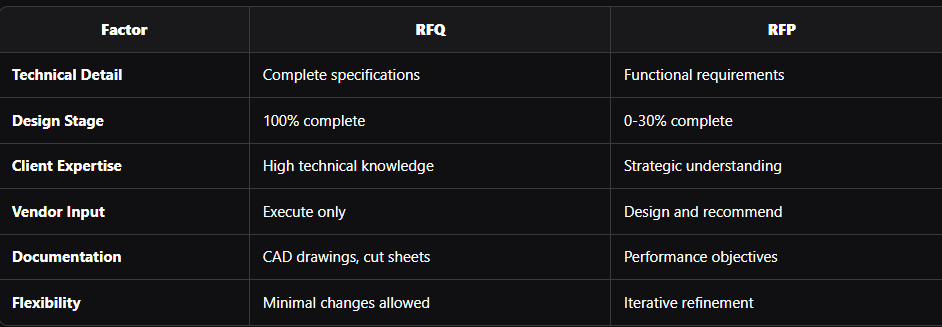
Specification Maturity Level
Risk and Accountability Distribution
RFQ risk profile:
- Client assumes full design risk and technical adequacy
- Vendors responsible only for installation quality
- Specification errors become expensive change orders
- Limited recourse if system doesn't meet unstated needs
- Clear performance standards reduce ambiguity
RFP risk profile:
- Vendors share design liability for recommended solutions
- Professional accountability for system performance
- Built-in value engineering opportunities
- Higher vendor responsibility for functional outcomes
- Requires robust evaluation framework to manage
Timeline and Resource Requirements
RFQ timelines:
- Specification development: 4-12 weeks (before RFQ release)
- Vendor response period: 2-3 weeks
- Evaluation and selection: 1-2 weeks
- Total procurement: 3-5 weeks (post-specifications)
RFP timelines:
- Requirements definition: 2-4 weeks
- RFP development: 2-3 weeks
- Vendor response period: 4-6 weeks
- Presentations and evaluation: 2-4 weeks
- Negotiation and contracting: 2-3 weeks
- Total procurement: 12-20 weeks
Cost Structure and Predictability
RFQs deliver highly comparable pricing data since all bidders quote identical requirements. This enables straightforward cost analysis and confident budget forecasting. However, you've already invested significantly in design costs before issuing the RFQ.
RFPs generate varied proposals that require sophisticated evaluation beyond simple price comparison. While initial cost uncertainty is higher, the process often reveals cost-saving alternatives and value-added services that improve overall project ROI.
When to Choose an RFQ for Your AV Project
Select the RFQ approach when specific conditions align with your project characteristics and organizational strengths.
You Have Complete Design Documentation
Issue an RFQ when you possess:
Essential documentation:
- Finalized architectural plans showing equipment locations
- Comprehensive equipment schedules with specific models
- Detailed wiring diagrams and signal flow documentation
- Rack elevations and equipment mounting specifications
- Control system programming requirements
- Testing protocols and commissioning procedures
- As-built standards and documentation deliverables
This level of detail typically comes from working with experienced AV consultants, internal technical staff, or replicating proven system designs.
Standardization and Repeatability
RFQs excel when deploying consistent solutions across multiple locations:
- Corporate conference rooms with standardized collaboration technology
- Retail locations requiring identical digital signage networks
- Educational spaces using approved classroom technology standards
- Hospitality properties implementing uniform guest room entertainment
- Healthcare facilities with regulated patient communication systems
Budget-Constrained Environments
When financial limitations are absolute and procurement departments demand precise cost forecasting, RFQs provide the clarity needed for approval processes and capital planning.
Equipment Replacement Projects
For technology refresh initiatives where existing infrastructure remains viable, RFQs efficiently price equipment upgrades without redesigning functional systems.
Competitive Bidding Requirements
Many public sector organizations, educational institutions, and large corporations mandate competitive bidding for procurement integrity. RFQs satisfy these requirements while maintaining specification control.
When to Choose an RFP for Your AV Project
RFPs become the superior choice when complexity, innovation requirements, or strategic considerations dominate your project landscape.
Complex Integration Requirements
Issue RFPs when your AV environment involves:
Technical complexity factors:
- Multiple technology platforms requiring seamless interoperability
- Legacy system integration with modern digital infrastructure
- Enterprise-wide deployments spanning diverse space types
- Network convergence projects integrating AV over IP
- Building automation requiring system integration with HVAC, lighting, and security
- Unified communications linking video conferencing, telephony, and collaboration software
Incomplete Technical Requirements
When you understand operational goals but lack the expertise to specify technical solutions, RFPs access professional knowledge from experienced system designers.
Ideal scenarios:
- New construction without predetermined AV infrastructure
- Organizational transformation requiring technology strategy
- User experience improvements with undefined technology paths
- Emerging technologies where best practices are still evolving
- Multi-stakeholder projects with conflicting requirements
Value Beyond Lowest Price
Choose RFPs when evaluation criteria extend well beyond cost:
Critical evaluation factors:
- Vendor qualifications and relevant project experience
- Implementation methodology and project management capabilities
- Training programs and change management support
- Service infrastructure and technical support availability
- Financial stability and long-term viability
- Innovation track record and technology partnerships
- Local presence and response time commitments
Design-Build Delivery Models
For projects requiring turnkey solutions with single-source accountability from concept through commissioning, RFPs establish integrated teams aligning design and execution.
Advantages and Disadvantages: Making the Right Choice
Every procurement method involves tradeoffs that impact project outcomes in the audiovisual integration field.
RFQ Advantages for AV Projects
Strategic benefits:
- Transparent cost comparison with minimal variables
- Accelerated procurement reducing project timelines
- Simplified vendor management with clear deliverables
- Budget certainty facilitating financial approvals
- Specification control maintaining technical preferences
- Accountability clarity with precise scope definition
- Reduced evaluation complexity focusing on price and qualifications
When RFQs excel: Perfect for equipment-focused projects where system design is complete and competitive pricing drives vendor selection.
RFQ Limitations
Potential challenges:
- Design risk remains entirely with client
- Limited innovation from competing contractors
- Specification errors become costly change orders
- Missed opportunities for value engineering
- Vendor commoditization reducing strategic partnerships
- Technical obsolescence if specifications aren't current
- Inflexibility when field conditions differ from assumptions
RFP Advantages for AV Environments
Strategic benefits:
- Expert knowledge access and industry best practices
- Creative solutions exceeding original vision
- Risk sharing with vendors accountable for design adequacy
- Comprehensive evaluation considering multiple success factors
- Strategic partnerships extending beyond transactions
- Adaptability as requirements evolve during planning
- Innovation driving competitive differentiation
When RFPs excel: Ideal for complex integration projects requiring design expertise, creative problem-solving, and strategic technology planning.
RFP Limitations
Potential challenges:
- Extended timelines impacting project schedules
- Evaluation complexity requiring sophisticated scoring
- Proposal variance complicating direct comparisons
- Higher client engagement throughout selection
- Potential scope creep without disciplined management
- Cost uncertainty until proposals received
- Resource intensive for both clients and vendors
AI and Automation in AV Procurement
As we advance through 2026, artificial intelligence and automation technologies are transforming the RFQ vs RFP landscape in audiovisual procurement.
AI-Powered Specification Development
Modern AI tools assist in creating comprehensive technical specifications:
Emerging capabilities:
- Machine learning algorithms analyzing thousands of AV installations to recommend optimal equipment configurations
- Natural language processing converting functional requirements into detailed specifications
- Automated compatibility checking preventing integration conflicts
- Predictive analytics forecasting technology lifecycles and replacement timing
- Cost modeling estimating project budgets based on historical data
Intelligent Vendor Matching
AI platforms now facilitate smarter vendor selection:
- Capability matching algorithms connecting project requirements with qualified integrators
- Performance analytics evaluating vendor track records across similar projects
- Risk assessment tools identifying potential red flags in vendor profiles
- Automated scoring of RFP responses using defined evaluation criteria
Digital Procurement Platforms
Cloud-based systems streamline both RFQ and RFP processes:
Platform features:
- Centralized document management ensuring version control
- Automated workflows for approvals and notifications
- Collaborative tools enabling stakeholder input and feedback
- Real-time analytics tracking procurement metrics
- Digital signatures and contract management
- Vendor portals simplifying response submission
Future Trends in AV Procurement
Technology evolution will further transform procurement methods:
- Virtual reality walkthroughs of proposed AV systems before installation
- Digital twins simulating system performance under various scenarios
- Blockchain-based contract execution and payment automation
- AI negotiation assistants optimizing contract terms
- Automated commissioning and system verification protocols
Decision Framework: Choosing Between RFQ vs RFP
Apply this systematic framework to determine the optimal procurement approach for your specific AV project.
Assessment Matrix
Rate your project across these dimensions:
Specification Completeness (1-5 scale)- 1: Functional requirements only
- 3: Partial specifications with gaps
- 5: Complete technical documentation
Score 4-5: RFQ appropriate Score 1-3: RFP recommended
Internal Technical Expertise (1-5 scale)- 1: Limited AV knowledge
- 3: Moderate understanding
- 5: Expert-level capabilities
Score 4-5: Can manage RFQ Score 1-3: Need RFP expertise
Project Complexity (1-5 scale)- 1: Simple, single-room installation
- 3: Multi-room with moderate integration
- 5: Enterprise-wide, multiple systems
Score 1-2: RFQ viable Score 3-5: RFP beneficial
Innovation Priority (1-5 scale)- 1: Proven solutions preferred
- 3: Open to alternatives
- 5: Innovation critical
Score 1-2: RFQ acceptable Score 3-5: RFP advantageous
Quick Decision Guide
Choose RFQ when:
- ✓ Specifications score 4-5 AND expertise score 4-5
- ✓ Complexity score 1-2 AND budget certainty critical
- ✓ Timeline pressure severe AND design complete
- ✓ Standardized deployment across multiple sites
- ✓ Equipment replacement with existing system architecture
Choose RFP when:
- ✓ Specifications score 1-3 OR expertise score 1-3
- ✓ Complexity score 3-5 AND innovation priority 3-5
- ✓ Strategic partnership valued over transactional relationship
- ✓ Multiple evaluation factors beyond price important
- ✓ Design-build delivery model desired
Hybrid Strategies
Some sophisticated projects benefit from combined approaches:
Two-stage procurement:
- Phase 1: RFP for conceptual design and system architecture
- Phase 2: RFQ for competitive installation pricing
Pre-qualified RFQ:
- Qualify vendors through capability assessment
- Issue RFQ only to pre-approved contractors
Tiered approach:
- Core systems: RFP for custom design
- Standard elements: RFQ for commodity items
Best Practices for Successful Procurement
Regardless of whether you choose RFQ vs RFP, these practices improve procurement outcomes.
Clear Documentation Standards
Essential elements:
- Unambiguous scope boundaries defining inclusions and exclusions
- Realistic project timelines with reasonable response periods
- Transparent evaluation criteria and selection process
- Complete site information including infrastructure details
- Defined deliverables and acceptance criteria
- Clear warranty and support expectations
Vendor Communication
Best practices:
- Pre-bid meetings allowing vendor questions
- Site visits for accurate assessment
- Written responses to all inquiries shared with all bidders
- Designated contact person for procurement questions
- Reasonable submission deadlines respecting vendor workloads
Evaluation Methodology
Effective approaches:
- Weighted scoring matrices for RFPs balancing multiple factors
- Blind evaluation processes reducing bias
- Cross-functional evaluation teams
- Reference checks with previous clients
- Presentations or demonstrations for shortlisted vendors
- Clear scoring documentation for audit trails
Frequently Asked Questions
What is the main difference between RFQ and RFP in AV projects?The fundamental difference in RFQ vs RFP is that RFQs request pricing for fully specified technical requirements, while RFPs solicit comprehensive design solutions and recommendations when specifications are incomplete. RFQs treat vendors as executors; RFPs engage them as solution partners contributing expertise to project success.
How long should I allow vendors to respond to an AV RFQ or RFP?For RFQs with complete specifications, allow 2-3 weeks for vendor responses. RFPs requiring system design and technical proposals need 4-6 weeks minimum. Complex enterprise-wide AV projects may warrant 6-8 weeks. Consider project scale, site complexity, and integrator workload when setting deadlines.
Can I negotiate after receiving RFQ responses?Yes, though negotiation scope differs from RFPs. With RFQs, you can typically negotiate payment terms, warranty extensions, or service level agreements, but changing technical specifications essentially creates a new RFQ. Significant specification changes should trigger re-bidding to maintain competitive integrity.
What should I prioritize when evaluating RFP responses?Use a weighted evaluation matrix considering: technical approach quality (30-35%), vendor qualifications and project references (20-25%), implementation methodology and project management (15-20%), support infrastructure and training (10-15%), and cost (20-25%). Never select based on price alone—the cheapest proposal often carries hidden project risks.
Do I need an AV consultant to create an RFQ?For complex AV systems, yes. AV consultants provide independent expertise ensuring specifications are technically sound, industry-standard, properly integrated, and vendor-neutral. Their design documentation forms the foundation for successful RFQs and protects you from specification errors that become expensive change orders.
How do I handle significant differences in RFP proposals?Create an evaluation framework assessing both technical merit and cost-effectiveness. Conduct vendor presentations to clarify approaches, check references thoroughly, and consider total cost of ownership beyond initial price. Request clarifications on significantly low or high bids. The best proposal balances innovation, feasibility, vendor capability, and reasonable pricing.
What happens if my project requirements change after issuing an RFQ or RFP?For RFQs, significant changes require issuing amendments to all bidders and potentially extending deadlines. Major changes may necessitate canceling and re-bidding. For RFPs, built-in flexibility allows refinement during proposal development through vendor questions and clarifications. Document all changes formally to maintain procurement transparency and fairness.
Conclusion
Mastering the RFQ vs RFP decision fundamentally impacts AV project success, influencing budget accuracy, implementation quality, timeline efficiency, and long-term system performance. RFQs deliver cost-effective procurement when you have complete technical specifications and need competitive pricing for well-defined scope. RFPs provide access to professional design expertise, innovative solutions, and strategic partnerships when project complexity demands more than transactional vendor relationships.
The most successful AV integrators, consultants, and facility managers in 2026 recognize that procurement isn't one-size-fits-all. They systematically assess specification completeness, internal expertise, project complexity, and strategic objectives before selecting their approach. They leverage emerging AI-powered tools to streamline processes while maintaining the human judgment essential for vendor evaluation and relationship building.
As audiovisual technology continues evolving with AI integration, cloud-based systems, and IoT connectivity, the principles underlying effective procurement remain constant: match your procurement method to your technical readiness and project needs. Whether you choose the precision of RFQs or the comprehensive approach of RFPs, success depends on clear documentation, transparent processes, and strategic thinking.
Apply these frameworks thoughtfully to your next AV procurement, and you'll optimize both project outcomes and vendor relationships while positioning your organization for technology success in an increasingly complex integration landscape.