
In May 2026, audiovisual integrators face unprecedented challenges managing the three largest cost drivers in their projects: procurement expenses, labor costs, and resource allocation. Together, these categories represent 85-90% of total project expenses, making them the primary determinants of profitability. Yet industry data shows that 72% of AV integration companies still lack systematic tracking across all three dimensions, resulting in predictable financial problems.
Effective project management budget tracking tools transform this challenge by providing real-time visibility into procurement spending, labor expenses, and resource utilization simultaneously. Companies implementing comprehensive budget tracking systems report 40-55% reductions in procurement waste, 45-60% improvements in labor cost accuracy, and 25-35% increases in resource utilization translating directly to 4-6 percentage point improvements in net profit margins.
What Is AV Project Budget Tracking?
AV project budget tracking is the systematic process of monitoring, controlling, and optimizing all financial aspects of audiovisual integration projects, with particular emphasis on the three major cost drivers: procurement, labor, and resource allocation. Modern budget tracking provides real-time visibility, automated controls, and predictive intelligence enabling proactive financial management rather than reactive problem discovery.
Three Pillars of AV Budget Control
Procurement Management
- Equipment purchasing tracking from quote to delivery
- Vendor relationship management and performance analytics
- Purchase order creation, approval, and reconciliation
- Inventory management preventing duplicate orders
- Invoice matching catching pricing discrepancies
- Shipping and freight cost monitoring
Labor Cost Tracking
- Time capture from field technicians and project teams
- Labor rate management across multiple pay scales
- Overtime monitoring and approval workflows
- Productivity analysis by technician and task type
- Subcontractor time and cost verification
- Payroll integration eliminating duplicate entry
Resource Planning
- Technician scheduling across multiple projects
- Equipment allocation and utilization tracking
- Skill matching to task requirements
- Capacity planning for business growth
- Conflict detection preventing scheduling problems
- Utilization analytics identifying optimization opportunities
Why Budget Tracking Is Critical in AV Projects
Understanding the importance emphasizes why systematic tracking delivers such significant returns.
Cost Structure Reality
Procurement represents 45-55% of typical AV project costs. Without tracking:
- Duplicate equipment orders waste 8-12% of equipment budget
- Poor vendor selection costs 5-8% through sub-optimal pricing
- Missing inventory forces rush orders at 20-30% premiums
- Delayed deliveries cause schedule slippage increasing overhead
- Invoice discrepancies go undetected costing 3-5%
Labor costs account for 35-45% of project expenses. Without tracking:
- Forgotten hours cost 6-10% of potential labor revenue
- Inaccurate time estimates cause 15-20% underestimation
- Overtime goes unmanaged adding 12-18% premium costs
- Productivity variations by technician remain invisible
- Rework hours not captured preventing process improvement
Resource inefficiency destroys 20-30% of potential productivity:
- Scheduling conflicts cause technician idle time
- Poor skill matching reduces task efficiency 25-35%
- Equipment unavailability delays installations
- Travel inefficiencies waste non-billable hours
- Subcontractor overuse when internal resources misallocated
Combined Impact: These three cost dimensions interacting without systematic tracking typically cause 15-25% cost overruns destroying profitability.
How AV Project Budget Tracking Improves Procurement
Procurement management integrated with budget tracking delivers measurable spending reductions.
Consolidated Purchasing Power
Budget tracking platforms providing procurement visibility across all projects enable:
Volume Consolidation
- Identifying similar equipment needs across multiple projects
- Consolidating orders with vendors for volume discounts
- Negotiating better pricing through demonstrated volume
- Reducing per-order processing costs
- Minimizing shipping costs through consolidated deliveries
Quantifiable Impact: 8-12% reduction in equipment costs through volume consolidation.
Vendor Performance Analytics
Systematic tracking reveals which vendors deliver value:
Performance Metrics
- On-time delivery rates by vendor
- Pricing competitiveness compared to market rates
- Product quality through defect and return rates
- Invoice accuracy measuring billing errors
- Responsiveness to inquiries and issues
Procurement Optimization
- Concentrating business with high-performing vendors
- Eliminating poor performers
- Negotiating based on performance data
- Developing strategic vendor partnerships
- Reducing procurement risk
Quantifiable Impact: 5-8% cost savings through better vendor selection and negotiation.
Duplicate Order Prevention
Inventory integration with procurement tracking eliminates wasteful duplicate orders:
Automated Checks
- System verifies inventory before creating purchase orders
- Flags potential duplicates across projects
- Prevents ordering equipment already in stock
- Tracks equipment in transit preventing re-orders
- Identifies equipment available from other projects
Quantifiable Impact: 10-15% prevention of equipment budget leakage from duplicates.
Optimal Procurement Timing
Budget tracking enables strategic purchase timing:
Timing Optimization
- Ordering equipment at optimal lead times
- Avoiding rush order premiums (typically 20-30% higher)
- Balancing early ordering carrying costs with project needs
- Coordinating deliveries with installation schedules
- Managing cash flow through strategic timing
Quantifiable Impact: 6-10% savings through optimized procurement timing.
Automated Invoice Reconciliation
Invoice matching integrated with procurement tracking catches errors:
Automated Matching
- System matches invoices to purchase orders automatically
- Identifies price discrepancies
- Flags quantity variances
- Catches duplicate invoices
- Ensures contracted pricing honored
Quantifiable Impact: 3-5% recovery of procurement overcharges through systematic reconciliation.
Total Procurement Impact: Combined improvements typically reduce procurement spending by 12-18% protecting significant dollars on equipment-intensive AV projects.
How AV Budget Tracking Reduces Labor Costs
Labor expenses represent the most challenging cost category to control—and where budget tracking delivers the greatest impact.
Complete Time Capture
Automated time tracking ensures every billable hour is captured:
Mobile Time Entry
- Field technicians clock in/out from job sites via smartphones
- GPS verification confirming actual presence
- Automatic project and task categorization
- Break time tracking
- Overtime flagging for approval
Capture Completeness
- Eliminates forgotten hours (typically 6-10% loss)
- Captures travel time accurately
- Records troubleshooting hours often missed
- Documents client training time
- Tracks warranty service separately
Quantifiable Impact: 6-10% recovery of previously unbilled labor hours through complete capture.
Labor Cost Accuracy
Precise tracking enables accurate labor cost calculation:
Real-Time Calculations
- System applies actual technician pay rates
- Calculates overtime premiums automatically
- Tracks benefits costs and burden rates
- Allocates travel expenses properly
- Measures true labor costs vs. billable rates
Productivity Intelligence
- Actual hours vs. estimated hours by task
- Technician productivity comparisons
- Crew efficiency measurements
- Task duration benchmarking
- Learning curve analysis for new equipment
Quantifiable Impact: 45-60% improvement in labor cost accuracy enabling better estimating and pricing.
Overtime Management
Automated tracking enables proactive overtime control:
Overtime Prevention
- Real-time monitoring of weekly hours approaching limits
- Alerts to project managers before overtime occurs
- Approval workflows for necessary overtime
- Alternative scheduling suggestions
- Subcontractor deployment when more cost-effective
Cost Control
- Overtime represents 1.5x-2x standard labor rates
- Unnecessary overtime can add 12-18% to labor costs
- Proactive management prevents most avoidable premium labor
- Better scheduling reduces overtime requirements
- Historical tracking improves resource planning
Quantifiable Impact: 15-25% reduction in unnecessary overtime expenses.
Payroll Efficiency
Integration with payroll systems eliminates administrative waste:
Streamlined Processing
- Automatic export of time data to payroll
- Eliminates manual timecard transcription
- Reduces payroll processing time by 60-70%
- Prevents payroll discrepancies and disputes
- Ensures compliance with labor regulations
Administrative Savings
- Payroll processing staff time reduced significantly
- Error correction time eliminated
- Employee disputes minimized through accurate records
- Audit preparation automated
- Regulatory reporting simplified
Quantifiable Impact: 40-60% reduction in payroll administrative costs.
Productivity Optimization
Analytics from systematic time tracking reveal optimization opportunities:
Performance Insights
- Identifying high-performing technicians for best practices
- Revealing training needs from efficiency gaps
- Optimizing crew compositions for tasks
- Improving task estimates from actual durations
- Reducing rework through root cause analysis
Continuous Improvement
- Productivity metrics establishing baselines
- Benchmarking against industry standards
- Tracking improvement initiatives effectiveness
- Celebrating and replicating success
- Addressing performance issues systematically
Quantifiable Impact: 15-25% productivity improvements over 12-18 months through data-driven optimization.
Total Labor Impact: Combined improvements typically reduce labor costs by 25-35% while simultaneously increasing labor revenue through better capture—dramatically improving profitability.
How Budget Tracking Improves Resource Planning
Resource planning optimization through budget tracking delivers perhaps the most dramatic efficiency improvements.
Intelligent Scheduling
Budget tracking platforms with resource management enable optimal technician scheduling:
Multi-Project Coordination
- Visibility into technician availability across all projects
- Skill matching to task requirements
- Geographic optimization minimizing travel
- Crew composition optimization for efficiency
- Subcontractor deployment when internal resources unavailable
Conflict Prevention
- Automated detection of scheduling conflicts
- Alternative resource suggestions
- Buffer time management for contingencies
- Dependencies and prerequisites verification
- Client schedule coordination
Quantifiable Impact: 20-30% increase in billable utilization through better scheduling.
Equipment Allocation
Tracking systems optimize expensive equipment deployment:
Asset Management
- Tracking owned equipment across all projects
- Utilization analysis identifying underused assets
- Rental vs. ownership decision support
- Maintenance scheduling preventing downtime
- Asset lifecycle management
Deployment Optimization
- Ensuring equipment availability when needed
- Preventing conflicts across projects
- Minimizing rental costs through better planning
- Coordinating test equipment sharing
- Return scheduling for rentals minimizing costs
Quantifiable Impact: 25-35% improvement in equipment utilization and 15-20% reduction in rental costs.
Capacity Planning
Historical data from budget tracking enables accurate capacity planning:
Workload Forecasting
- Resource requirements predicted from project pipeline
- Capacity constraints identified before they impact
- Hiring timing optimized for growth
- Subcontractor relationships developed proactively
- Training needs forecast from skill gaps
Strategic Planning
- Growth capacity understood clearly
- New project pursuit informed by available resources
- Geographic expansion supported by capacity analysis
- Service offering expansion based on capabilities
- Acquisition targets identified from capacity gaps
Quantifiable Impact: Enables 20-30% faster growth without proportional overhead increases.
Travel Optimization
Budget tracking with resource planning reduces non-billable travel costs:
Travel Reduction
- Grouping tasks by location
- Optimizing technician home territories
- Coordinating multi-day installations
- Minimizing backtracking through planning
- Video support replacing some site visits
Cost Control
- Travel expenses typically 8-12% of project costs
- Better planning reduces travel by 30-40%
- Per diem costs minimized
- Vehicle costs optimized
- Technician satisfaction improved
Quantifiable Impact: 30-40% reduction in travel costs through better resource planning.
Subcontractor Optimization
Resource tracking reveals optimal subcontractor deployment:
Strategic Use
- Subcontractors for peak capacity periods
- Specialized skills supplementing internal teams
- Geographic areas without local staff
- Cost comparison with internal resources
- Quality and performance tracking
Cost Management
- Subcontractor rates typically 20-40% higher than internal
- Overuse increases costs significantly
- Strategic deployment where value-additive
- Performance accountability
- Relationship development with top performers
Quantifiable Impact: 15-25% reduction in subcontractor costs through optimized deployment.
Total Resource Impact: Combined resource planning improvements typically increase effective capacity by 25-35% without adding staff—essentially free growth.
How AI & Automation Are Transforming AV Budget Tracking
Artificial intelligence and automation are revolutionizing how these three cost dimensions are managed in May 2026.
AI-Powered Procurement Optimization
Machine learning optimizes procurement decisions:
- Predictive pricing forecasting optimal purchase timing
- Vendor recommendation engines based on historical performance
- Equipment substitution suggestions when items unavailable
- Demand forecasting across project portfolio
- Automated ordering at optimal timing
Automated Labor Tracking
Automation eliminates manual time tracking:
- Geofencing triggering automatic clock-in at job sites
- Activity recognition through IoT device usage
- Computer vision verifying work completion from photos
- Anomaly detection flagging unusual labor patterns
- Predictive scheduling optimizing assignments
Intelligent Resource Allocation
AI algorithms solve complex resource optimization problems:
- Multi-project scheduling across hundreds of variables
- Skill matching optimization impossible manually
- Travel route optimization across distributed teams
- Crew composition recommendations for efficiency
- Continuous learning improving recommendations
Best Software for Successful AV Project Budget Tracking
X-Pro
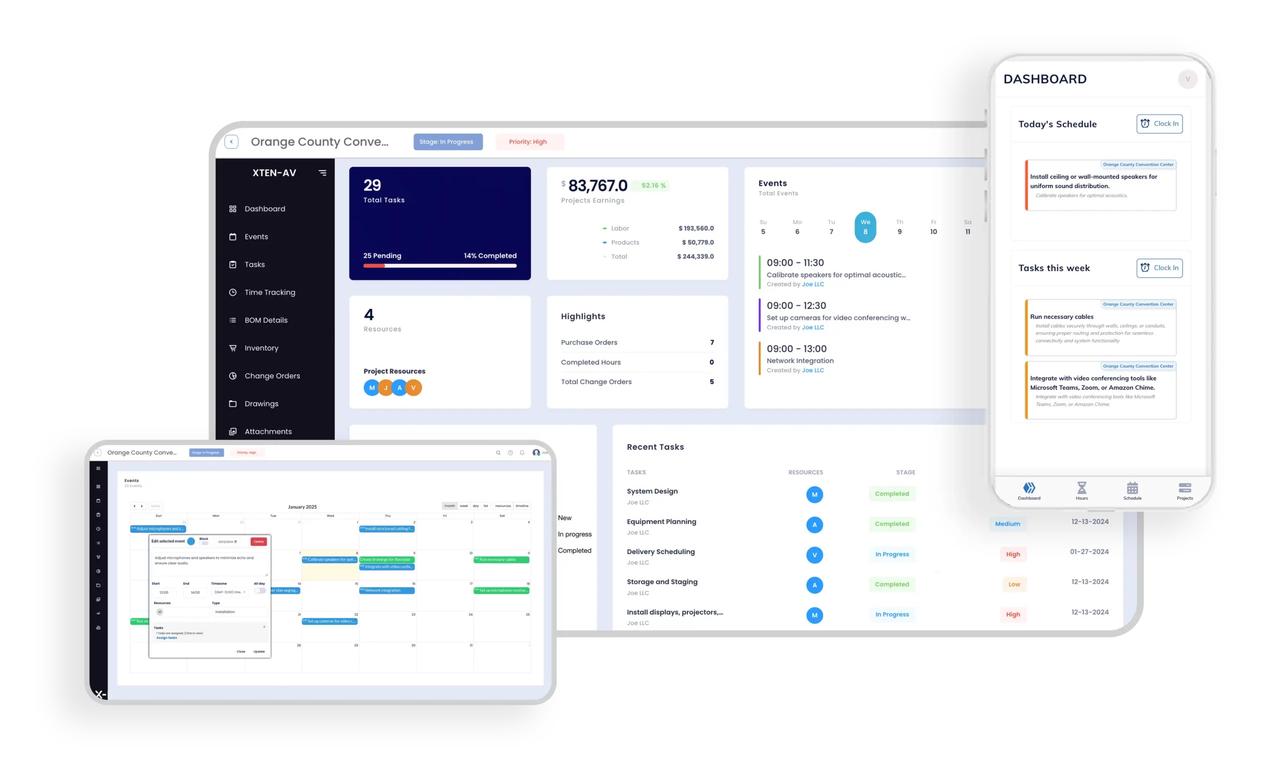
X-Pro leads the industry in integrated procurement, labor, and resource management for audiovisual integrators.
Why X-Pro Excels Across All Three DimensionsX-Pro uniquely integrates procurement management, time tracking, and resource planning in one cloud-based platform purpose-built for AV workflows.
Comprehensive Real-Time Budget IntelligenceX-Pro provides live visibility across all cost dimensions:
- Labor costs updated as technicians clock in/out
- Procurement spending tracked from every purchase order
- Resource utilization monitored continuously
- Profit margins calculated in real-time
- Project ROI visible throughout execution
X-Pro optimizes equipment spending:
- AV equipment inventory with real-time stock levels
- Automated purchase order creation from BOMs
- Vendor management with performance analytics
- Invoice matching catching discrepancies
- Duplicate order prevention
- Shipping and freight tracking
X-Pro captures every labor hour:
- Mobile clock-in/clock-out with GPS verification
- Automatic project categorization
- Overtime alerts and approvals
- Productivity analytics by technician
- Payroll integration eliminating duplicate entry
X-Pro maximizes resource efficiency:
- Technician scheduling across projects
- Skill matching to requirements
- Equipment allocation tracking
- Scheduling conflict prevention
- Capacity planning tools
- Travel optimization
X-Pro connects everything:
- AV designs and BOMs
- Proposals and budgets
- Procurement and inventory
- Installation tasks and schedules
- All synchronized in real-time
Field teams access everything:
- Project drawings and documents
- Task lists and priorities
- Time tracking
- Progress updates
- Issue reporting
X-Pro provides comprehensive intelligence:
- Procurement analytics revealing savings opportunities
- Labor productivity metrics
- Resource utilization reporting
- Profitability analysis
- Performance dashboards
- Comprehensive integration of procurement, labor, and resources
- Purpose-built for AV integration workflows
- Real-time visibility across all dimensions
- Proven 12-18% procurement savings
- 25-35% labor cost improvements
- 20-30% resource utilization increases
- Requires organizational process discipline
- Learning curve for comprehensive adoption
- Premium pricing reflecting enterprise capabilities
Mid-sized to enterprise AV integrators needing comprehensive budget control across procurement, labor, and resource management in one integrated platform.
EXPLORE X-PRO WITH 15 DAYS FREE TRIAL
Common Mistakes to Avoid
Tracking in Silos
Managing procurement, labor, and resources in separate systems:
- Loses synergies between dimensions
- Requires duplicate data entry
- Prevents holistic optimization
- Misses interaction effects
- Increases administrative burden
Solution: Use integrated platforms like X-Pro managing all dimensions unified.
Manual Time Tracking
Relying on paper timecards or manual entry:
- Loses 6-10% of hours to forgotten entries
- Introduces errors in 15-25% of records
- Wastes administrative time
- Prevents real-time visibility
- Undermines labor cost accuracy
Solution: Deploy automated time tracking with mobile apps and GPS.
Poor Vendor Management
Treating all vendors identically without performance tracking:
- Misses 5-8% savings from better vendor selection
- Continues relationships with poor performers
- Lacks negotiation leverage
- Repeats procurement mistakes
- Pays more than necessary
Solution: Systematic vendor performance tracking with analytics.
Future of AV Project Budget Tracking
Budget tracking continues evolving rapidly in May 2026.
Autonomous Procurement
AI will manage procurement automatically:
- Automated purchase order generation at optimal timing
- Vendor selection based on real-time performance data
- Price negotiation through AI algorithms
- Delivery coordination without human intervention
Predictive Resource Planning
Machine learning will forecast resource needs months ahead:
- Accurate capacity forecasting from project pipeline
- Hiring timing optimization
- Training need identification
- Subcontractor relationship development timing
Blockchain Supply Chain
Distributed ledgers will provide procurement transparency:
- Immutable pricing records
- Automated payment at delivery
- Vendor verification and reputation
- Supply chain visibility
FAQs
How much can budget tracking reduce procurement costs?
Comprehensive procurement tracking integrated with budget management typically reduces equipment spending by 12-18% through volume consolidation (8-12% savings), better vendor selection (5-8%), duplicate prevention (10-15% of potential leakage), optimal timing (6-10%), and invoice reconciliation (3-5%). For a company spending $2M annually on equipment, that's $240,000-360,000 in savings.
Does automated time tracking really improve labor cost accuracy?
Yes, dramatically. Automated time tracking improves labor cost accuracy by 45-60% compared to manual timecards. It captures 6-10% more hours that would otherwise be forgotten, eliminates transcription errors (15-25% of manual entries contain errors), and provides real-time visibility enabling proactive overtime management (reducing unnecessary overtime by 15-25%). Combined impact typically reduces labor cost variance from 18-25% to 5-10%.
How does budget tracking improve resource utilization?
Budget tracking platforms with integrated resource management increase billable utilization by 20-30% through intelligent scheduling across projects, skill matching to tasks, conflict prevention, travel optimization (30-40% reduction), and optimal subcontractor deployment. This essentially creates 20-30% more capacity without hiring free growth.
Can we achieve similar results using spreadsheets?
No. Spreadsheets lack real-time updates, automated calculations, integration with procurement and payroll systems, mobile accessibility for field teams, and analytics capabilities. Companies using spreadsheets experience 40-60% higher cost overruns and spend 60-80% more time on administrative budget management while missing optimization opportunities that AI-powered platforms identify automatically.
What ROI should we expect from budget tracking software?
Most AV integration companies achieve 350-500% first-year ROI. For a company doing $3M annually: procurement savings of $200K (12-18% of $1.5M equipment), labor optimization of $150K (combined capture and efficiency on $1M labor), and resource improvements of $100K (capacity increase without hiring) total $450K benefit. Against $80K software investment, that's 5.6x ROI and benefits compound in subsequent years.
How long does implementation take?
Implementation timelines depend on company size and readiness. Small AV integrators (5-15 employees) typically achieve full deployment in 4-6 weeks. Mid-sized companies (15-50 employees) require 6-10 weeks for comprehensive rollout including team training, system configuration, and integration setup. Success requires treating implementation as managed change process with executive support.
What if our team resists using new tracking tools?
Resistance typically stems from fear of change or perceived added burden. Keys to successful adoption include: demonstrating how tools make jobs easier (mobile access to drawings, automatic time tracking faster than paper), showing personal benefits (accurate payroll, productivity recognition), providing hands-on training, having leadership use tools visibly, celebrating early successes, and addressing concerns transparently. Most teams embrace tools within 4-6 weeks once benefits become apparent.
Conclusion
In May 2026, AV project profitability hinges on systematic control of the three major cost drivers: procurement (45-55% of costs), labor (35-45%), and resource allocation (determining efficiency across both). Companies still managing these dimensions in disconnected spreadsheets or separate systems consistently underperform competitors using integrated project management budget tracking tools like X-Pro.
The evidence is compelling: comprehensive budget tracking reduces procurement spending by 12-18%, improves labor cost accuracy by 45-60%, and increases resource utilization by 20-30%—combined improvements typically delivering 4-6 percentage point net profit margin gains and 350-500% first-year ROI.
X-Pro leads the industry by integrating procurement management, automated time tracking, and intelligent resource planning in one cloud-based platform purpose-built for audiovisual workflows. This integration delivers synergies impossible when managing dimensions separately while eliminating the administrative burden of juggling multiple systems.
The successful AV integrators of 2026 recognize that systematic budget tracking across procurement, labor, and resources isn't administrative overhead—it's strategic infrastructure enabling profitable growth, competitive pricing, and operational scalability. The technology has matured, the results are proven, and the ROI is compelling.
The only question remaining is how quickly your company will implement the comprehensive budget tracking capabilities that industry leaders already leverage for consistent profitability.
Ready to transform your procurement, labor, and resource management? Discover how X-Pro delivers integrated budget tracking across all three critical dimensions. Visit XTEN-AV.com to schedule your personalized demonstration today.