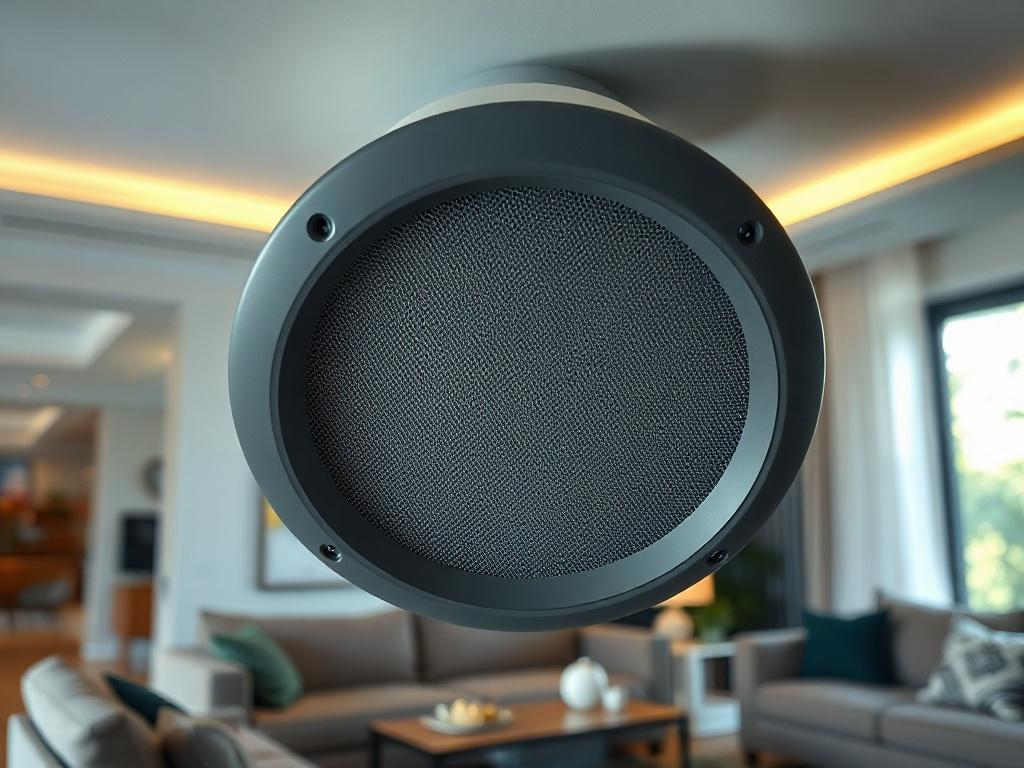
Selecting the appropriate speaker size for ceiling mount surround sound speakers directly impacts audio performance, installation complexity, and client satisfaction in residential and commercial AV systems. The optimal driver diameter depends on multiple factors: room dimensions (cubic volume and ceiling height), intended application (home theater vs. background music), acoustic characteristics (RT60 reverberation time and surface materials), and system design (speaker quantity and amplifier power). Generally, 5.25-inch speakers suit small rooms (100-200 sq ft), 6.5-inch drivers serve medium spaces (200-400 sq ft), and 8-inch woofers handle large areas (400+ sq ft) or critical listening applications. The importance of choosing the best ceiling mount surround sound speakers with appropriate driver sizes cannot be overstated—undersized speakers produce thin, anemic sound lacking bass impact and dynamic range, while oversized drivers in small rooms create overwhelming bass and installation challenges from excessive cut-out diameters and ceiling cavity depth requirements.
Beyond simple diameter selection, AV professionals must consider woofer excursion capabilities, sensitivity ratings (dB @ 1W/1m), frequency response (particularly bass extension), power handling, and physical dimensions including mounting depth and cut-out size that affect installation feasibility. Modern speaker technologies in June 2026—including long-throw woofer designs, carbon fiber cones, **neo
dymium magnets**, and optimized enclosures—enable smaller drivers to deliver performance previously requiring larger sizes, complicating selection decisions for integrators balancing acoustic performance, aesthetic impact, and budget constraints.
This comprehensive guide provides AV integrators and system designers with evidence-based recommendations for speaker size selection, examining performance trade-offs, application-specific requirements, and practical installation considerations that ensure optimal results in ceiling-mounted surround sound
installations.
Key Takeaways
- Speaker size selection for ceiling mount surround sound speakers primarily depends on room size: 5.25" for <200 sq ft, 6.5" for 200-400 sq ft, 8" for 400+ sq ft
- Woofer diameter directly impacts bass extension (5.25" typically -3dB at 70-80Hz, 6.5" at 60-70Hz, 8" at 50-60Hz), dynamic range, and maximum SPL capabilities
- Mounting depth requirements increase with speaker size: 5.25" speakers need 3-4" depth, 6.5" require 4-5", 8" need 5-6"+—verify ceiling cavity clearance before specification
- Multiple smaller speakers often outperform fewer larger drivers in even coverage, spatial distribution, and flexibility—consider four 6.5" speakers vs. two 8" speakers for large rooms
- Sensitivity ratings matter as much as size: High-efficiency 6.5" speaker (90dB sensitivity) can match standard 8" model (87dB) with half the amplifier power
- Cut-out diameters range from 6-7" (5.25" speakers) to 9-10" (8" speakers)—larger cut-outs increase installation difficulty and ceiling weakness
- Application-specific recommendations: Background music (5.25-6.5"), home theater surrounds (6.5-8"), front LCR channels (8-10"), Atmos height speakers (6.5-8")
- Room acoustics influence requirements: Hard surfaces (tile, hardwood) benefit from smaller speakers with controlled dispersion; carpeted, furnished rooms accommodate larger drivers
Understanding Speaker Size Basics
What "Speaker Size" Actually Means
Speaker size refers to the nominal diameter of the primary driver (typically the woofer) measured in inches.
Common sizes for ceiling speakers:
- 3-inch: Utility applications (announcements, minimal music)
- 4-inch: Background music in small spaces
- 5.25-inch: General-purpose residential installations
- 6.5-inch: Most popular for home theater and distributed audio
- 8-inch: Premium installations requiring extended bass and high SPL
- 10-inch: Specialty applications (rare in ceiling mount due to size/weight)
Note: Actual driver diameter differs from nominal size (a "6.5-inch" woofer often measures 6.25" or 6.75" cone diameter).
Why Size Matters for Ceiling Installation
Physical implications:
Larger drivers provide: ✓ Greater bass extension (lower -3dB point) ✓ Higher maximum SPL (more air displacement) ✓ Better dynamic range (handling loud passages without distortion) ✓ Improved efficiency (less amplifier power needed for same output)
But require: ✗ Larger ceiling cut-outs (structural concerns) ✗ Greater mounting depth (ceiling cavity limitations) ✗ Heavier weight (drywall support issues) ✗ Higher cost (typically $100-200 more per speaker for equivalent quality)
Room Size and Speaker Size Relationship
Calculating Room Requirements
Basic formula: Speaker coverage area = 100-150 sq ft per speaker (for distributed audio)
Critical listening (home theater): 25-50% greater coverage per speaker
Small Rooms (100-200 Square Feet)Examples: Bedrooms, small offices, bathrooms
Recommended speaker size: 5.25-inch
Typical configuration:
- Single speaker: Background music adequate
- Stereo pair (2 speakers): Better imaging
- 5.1 surround: 5.25" × 5 speakers + 8" or 10" subwoofer
Performance characteristics:
- Adequate bass for small enclosed spaces (room gain reinforces low frequencies)
- 70-80Hz bass extension sufficient with subwoofer handling <80Hz
- Maximum SPL: 95-100dB at listening position (adequate for most residential use)
Examples: Living rooms, master bedrooms, medium conference rooms
Recommended speaker size: 6.5-inch
Typical configuration:
- Stereo pair: Minimum for music listening
- 5.1 surround: 6.5" × 5 + subwoofer
- 7.1 or 5.1.2 Atmos: 6.5" × 7-8 + subwoofer
Performance advantages:
- 60-70Hz bass extension providing fuller sound even before subwoofer engagement
- Better dynamic range handling movie soundtracks and loud music
- 102-107dB maximum SPL suitable for immersive home theater
Examples: Great rooms, open-concept spaces, auditoriums
Recommended speaker size: 8-inch (or multiple 6.5-inch)
Typical configurations:
Option 1: Fewer large speakers
- 5.1 system: 8" × 5 + subwoofer(s)
- Advantages: Deep bass, high output, fewer amplifier channels
- Disadvantages: Uneven coverage, installation challenges
Option 2: More medium speakers
- 7.1.4 system: 6.5" × 11 + subwoofer(s)
- Advantages: Even coverage, easier installation, flexibility
- Disadvantages: More amplifier channels, higher total cost
Performance requirements:
- 50-60Hz bass extension maintaining full-range presence in large volumes
- 110+ dB SPL capability filling expansive spaces
- Wide dispersion (multiple speakers) or high output (fewer speakers)
Detailed Speaker Size Comparison
5.25-Inch Ceiling Speakers
Specifications (typical quality model):
Parameter
Typical Range
Frequency response
70-20,000 Hz ±3dB
Sensitivity
87-89 dB @ 1W/1m
Power handling
50-75W continuous
Maximum SPL
95-100 dB
Mounting depth
3-4 inches
Cut-out diameter
6-7 inches
Weight
2-4 lbs
Price range
$100-250/pair
Best applications:
- Background music in small to medium rooms
- Surround channels in compact home theaters
- Height channels (Atmos) in any sized room
- Multi-zone audio installations
- Spaces with limited ceiling depth
Limitations:
- Limited bass output below 70Hz
- Lower maximum volume (inadequate for large rooms or loud listening)
- Reduced dynamic range for demanding movie soundtracks
6.5-Inch Ceiling Speakers
Specifications (typical quality model):
Parameter
Typical Range
Frequency response
60-20,000 Hz ±3dB
Sensitivity
88-91 dB @ 1W/1m
Power handling
75-125W continuous
Maximum SPL
102-107 dB
Mounting depth
4-5 inches
Cut-out diameter
7.5-8.5 inches
Weight
4-6 lbs
Price range
$150-400/pair
Best applications:
- Home theater primary channels (LCR and surrounds)
- Distributed audio in medium to large rooms
- General-purpose installations balancing performance and practicality
- Commercial spaces (restaurants, retail, offices)
Advantages:
- Optimal balance of size, performance, and cost
- Adequate bass for full-range music with subwoofer support
- Sufficient SPL for most residential applications
- Reasonable installation requirements
8-Inch Ceiling Speakers
Specifications (typical quality model):
Parameter
Typical Range
Frequency response
50-20,000 Hz ±3dB
Sensitivity
89-93 dB @ 1W/1m
Power handling
100-200W continuous
Maximum SPL
108-113 dB
Mounting depth
5-6+ inches
Cut-out diameter
9-10 inches
Weight
6-10 lbs
Price range
$250-600/pair
Best applications:
- Front LCR channels in dedicated home theaters
- Large room coverage with fewer speakers
- High-performance installations requiring extended bass and dynamics
- Commercial venues needing high SPL (within ceiling speaker context)
Considerations:
- Ceiling depth often limiting factor (many residential ceilings only 5-6" deep)
- Cut-out size approaching structural concern thresholds
- Weight may require additional support beyond standard mounting clips
- Overkill for small rooms (bass can be overwhelming)
Application-Specific Size Recommendations
Home Theater Systems
Channel-by-channel guidance:
Front LCR (Left, Center, Right) ChannelsRecommendation: 8-inch (preferred) or 6.5-inch (acceptable)
Rationale:
- Front channels handle 80% of soundtrack content including dialogue, music, and effects
- Extended bass (50-60Hz) reduces subwoofer burden, creating more natural integration
- High SPL capability ensures dynamics during action sequences
- Larger drivers provide better off-axis response for multiple seating positions
Installation note: Center channel especially benefits from 8-inch driver providing improved dialogue clarity and weight
Surround Channels (Side and Rear)Recommendation: 6.5-inch (optimal) or 5.25-inch (budget/space-constrained)
Rationale:
- Surrounds primarily handle ambient effects and occasional discrete sounds
- Bass content in surrounds limited compared to fronts
- 6.5-inch provides sufficient output while being easier to install than 8-inch
- Multiple smaller speakers often better for envelopment than fewer large ones
Recommendation: 6.5-inch (preferred) or 5.25-inch (acceptable)
Rationale:
- Height channels produce overhead effects (rain, aircraft, ambient ceiling sounds)
- Content typically less bass-heavy than bed channels
- 5.25-inch adequate for most height effects
- 6.5-inch provides better dynamics for intense overhead sequences
Note: Some integrators use smaller heights (5.25") with larger bed channels (8" LCR + 6.5" surrounds) as cost-effective compromise
Distributed Audio Systems
Background music applications:
Small zones (bathrooms, closets, small offices):
- Size: 4-5.25 inches
- Quantity: 1-2 speakers per zone
- Configuration: Mono or stereo
Medium zones (bedrooms, kitchens, medium offices):
- Size: 6.5 inches
- Quantity: 2-4 speakers
- Configuration: Stereo pairs for imaging
Large zones (great rooms, conference rooms, retail spaces):
- Size: 6.5-8 inches
- Quantity: 4-8+ speakers depending on coverage needs
- Configuration: Multiple zones or single large zone
General principle: Distributed audio prioritizes even coverage over critical listening—multiple smaller speakers typically outperform fewer large speakers in spatial uniformity
Commercial Applications
Specific venue recommendations:
Restaurants and Bars:
- Size: 6.5 inches (most common)
- Density: 1 speaker per 75-100 sq ft
- Rationale: Background levels with ability to increase volume during events
Retail Stores:
- Size: 5.25-6.5 inches
- Density: 1 speaker per 100-150 sq ft
- Rationale: Ambient music without overwhelming customers or staff
Conference Rooms:
- Size: 6.5-8 inches
- Configuration: Distributed for speech reinforcement OR dedicated surround for video conferencing
- Rationale: Speech intelligibility priority, with music capability secondary
Houses of Worship:
- Size: 8-10 inches (or commercial-grade 6.5")
- Density: Calculated for 60-70% direct sound coverage
- Rationale: High SPL requirements, speech intelligibility critical
Technical Factors Affecting Size Selection
Sensitivity and Power Handling
Understanding sensitivity ratings:
Sensitivity (dB @ 1W/1m):
- 85-87 dB: Low efficiency (needs more power)
- 88-90 dB: Average efficiency
- 91-93 dB: High efficiency (needs less power)
- 94+ dB: Very high efficiency (professional/commercial grade)
Practical impact:
Example comparison:
- 6.5" speaker with 90dB sensitivity + 50W amplifier = 107dB SPL at 1 meter
- 8" speaker with 87dB sensitivity + 50W amplifier = 104dB SPL at 1 meter
Conclusion: High-efficiency 6.5" can outperform lower-efficiency 8" speaker with same amplification
Power handling considerations:
Continuous power rating:
- Indicates safe long-term operation level
- Match or exceed amplifier output by 20-30% for headroom
Peak power:
- Marketing spec (less useful)—focus on continuous rating
Frequency Response and Bass Extension
How size affects frequency range:
General relationship:
- Larger woofers → Lower bass extension
- 3dB point (frequency where output drops 3dB) indicates bass limit
Typical bass extension:
- 5.25" speaker: 70-80 Hz -3dB point
- 6.5" speaker: 60-70 Hz -3dB point
- 8" speaker: 50-60 Hz -3dB point
Why this matters:
Crossover with subwoofer:
- Standard crossover: 80 Hz (THX recommendation)
- 5.25" speaker with 75Hz -3dB point: Marginal overlap, may sound thin
- 6.5" speaker with 65Hz -3dB: Good overlap, smooth transition
- 8" speaker with 55Hz -3dB: Excellent overlap, robust low-mids
Rooms without subwoofers:
- Music listening: 8" speakers provide more satisfying bass
- Dialogue-focused (news, podcasts): 5.25" adequate
Mounting Depth and Cut-Out Requirements
Critical installation constraints:
Ceiling cavity depth:
- Residential: Typically 5.5-6 inches (standard 2×6 joists)
- Commercial: Varies widely (drop ceilings often 6-12+ inches)
Speaker mounting depth requirements:
Speaker Size
Typical Depth
Safe Ceiling Depth
5.25"
3-4"
4.5" minimum
6.5"
4-5"
5.5" minimum
8"
5-6"
7" minimum
Clearance considerations:
- Allow 0.5-1 inch clearance above speaker for ventilation
- Insulation in cavity can interfere—may need backing boxes
- HVAC ducts, electrical conduit, plumbing reduce usable depth
Cut-out size implications:
Structural concerns:
- 6-7" cut-out (5.25"): Minimal structural impact
- 7.5-8.5" cut-out (6.5"): Acceptable in most ceiling types
- 9-10" cut-out (8"): Approaching joist spacing (typically 16" centers)—plan carefully
Installation difficulty:
- Larger cut-outs: More drywall dust, longer cutting time, greater risk of error
When to Use Multiple Smaller Speakers vs. Fewer Larger Speakers
The "Many Small vs. Few Large" Decision
Advantages of multiple smaller speakers:
✓ Even sound distribution across listening area ✓ Easier installation (smaller cut-outs, less depth) ✓ Greater flexibility in positioning (avoiding obstacles) ✓ Reduced ceiling stress (lighter individual units) ✓ Better for asymmetric rooms (custom coverage patterns)
Advantages of fewer larger speakers:
✓ Lower amplifier channel count (cost savings) ✓ Fewer ceiling penetrations (aesthetic preference) ✓ Potentially higher SPL from each location ✓ Extended bass from each speaker ✓ Simpler system design (fewer speakers to calibrate)
Application-Based Decision Matrix
Choose multiple smaller speakers when:
- Room has irregular shape or obstacles
- Even coverage more important than peak output
- Ceiling depth limited (<5 inches)
- Budget allows (more speakers + more amplifier channels)
- Open-concept space needs distributed sound
Choose fewer larger speakers when:
- Regular rectangular room with unobstructed ceiling
- High SPL required (home theater emphasis)
- Limited amplifier channels available
- Aesthetic preference for minimal ceiling penetrations
- Ceiling has adequate depth (6+ inches)
Practical Example
Large room (500 sq ft, 20' × 25'):
Option A: Four 8-inch speakers
- Coverage: 125 sq ft per speaker
- Amplifier channels: 4
- Total cost: ~$1,200 (speakers) + ~$600 (amplification)
- Result: High SPL, strong bass, potential coverage gaps near walls
Option B: Six 6.5-inch speakers
- Coverage: 83 sq ft per speaker
- Amplifier channels: 6
- Total cost: ~$1,200 (speakers) + ~$900 (amplification)
- Result: Even coverage, adequate SPL, less bass from each speaker
Recommendation: Option B for distributed audio or music listening; Option A if dedicated surround system with subwoofer handling bass
Future Trends: AI-Optimized Speaker Selection
Smart Room Analysis Tools
Emerging technology (June 2026):
AI-powered room analyzers:
- Smartphone apps using LiDAR to scan room dimensions
- Machine learning algorithms analyzing room acoustics from test tones
- Automatic recommendations for speaker size, quantity, and placement
Current availability:
- Beta testing in premium AVR manufacturers (Denon, Marantz, Anthem)
- Professional tools for integrators (subscription-based services)
How it works:
- User scans room with smartphone creating 3D model
- App identifies ceiling height, surface materials, furniture
- AI calculates reverberation time, room modes, acoustic treatment needs
- System recommends specific speaker models and sizes based on database of tested installations
Benefits for integrators:
- Faster design process (preliminary recommendations in minutes)
- Data-driven decisions replacing experience-based guessing
- Client confidence from visual simulations showing coverage patterns
Adaptive Speaker Systems
Next-generation concepts:
Modular speaker arrays:
- Ceiling speakers with multiple independently-powered drivers
- DSP adjusts active drivers based on room acoustics and content
- Example: 8-inch speaker uses full driver for bass-heavy content, switches to 4-inch center portion for dialogue
Self-optimizing installations:
- Speakers with built-in measurement microphones
- Automatic level and EQ adjustments based on room response
- No manual calibration required
Timeline: Premium products emerging late 2026, mainstream availability 2027-2028
Frequently Asked Questions
What size ceiling speakers do I need for a 300 square foot home theater?For a 300 sq ft home theater, 6.5-inch ceiling mount surround sound speakers provide optimal performance balancing bass response, dynamic range, and installation practicality. Recommended configuration: 5.1 system with 8-inch LCR (front left/center/right) if ceiling depth allows (6+ inches), or 6.5-inch for all channels if depth limited. Surround channels perform well with 6.5-inch drivers, and add one or two 10-12 inch subwoofers handling <80Hz. Avoid 5.25-inch for main channels in this size room—insufficient output for immersive theater. 8-inch speakers require verification of ceiling cavity depth (typically need 6+ inches) before specification.
Can I mix different size ceiling speakers in the same system?Yes, mixing speaker sizes is common best practice in well-designed systems. Typical approach: Larger drivers (8") for front LCR channels handling most content, medium drivers (6.5") for surrounds, and smaller drivers (5.25") for height channels (Atmos). Critical requirement: Match timbral characteristics—use same brand/product line ensuring similar tonal balance despite size differences. AVR calibration compensates for sensitivity and frequency response variations through level adjustments, delays, and EQ. Avoid: Mixing budget and premium speakers (creates noticeable quality differences) or drastically different technologies (horn-loaded with conventional dome tweeters).
Will 8-inch ceiling speakers fit in my ceiling?8-inch speakers require verification before purchase. Check three dimensions: Ceiling cavity depth (need 6-7 inches minimum including clearance—measure between drywall and floor/joists above), cut-out diameter (9-10 inches typical—ensure no joists or obstacles in cut location), and weight support (8" speakers weigh 6-10 lbs—may need additional support brackets attached to joists). Common obstacles: HVAC ducts, electrical conduit, plumbing pipes, insulation. Solution if insufficient depth: 6.5-inch speakers (5-inch depth) or install backing boxes creating sealed enclosure extending into room above (only possible in multi-story homes).
Are 5.25-inch ceiling speakers too small for surround sound?5.25-inch ceiling speakers work well for specific surround applications: Surround channels in small to medium rooms (<300 sq ft), height channels (Atmos) in any sized room, and complete systems in small spaces (<200 sq ft) with subwoofer. Limitations: Insufficient as main LCR channels in rooms >200 sq ft, limited maximum SPL (95-100dB—inadequate for loud theater listening), and weak bass output below 70Hz (requires subwoofer). Recommendation: 5.25" appropriate for surrounds/heights in budget systems or space-constrained installations; upgrade to 6.5" or 8" for front channels in dedicated theaters.
How do I determine the correct number of ceiling speakers for my room?Calculate coverage using two methods: Room area approach: Divide total sq ft by coverage per speaker (100-150 sq ft for background music, 75-100 sq ft for better coverage, 50-75 sq ft for critical listening). Example: 400 sq ft room ÷ 100 sq ft/speaker = 4 speakers minimum. Ceiling height factor: Higher ceilings (10+ feet) require more speakers or larger drivers—add 20% more speakers or upsize by one diameter (6.5" → 8"). Surround sound systems: Follow channel layout (5.1, 7.1, 5.1.2, etc.) regardless of room size. Verification: Use online coverage calculators from JBL, Klipsch, or professional AV tools for precise calculations.
Do I need professional installation for larger ceiling speakers?8-inch ceiling speakers benefit from professional installation due to complexity: Structural assessment ensuring ceiling can support weight (6-10 lbs per speaker), ceiling cavity verification confirming adequate depth and no obstacles, precise cutting of 9-10 inch openings without damaging joists or utilities, and potential reinforcement of mounting points. DIY feasible for experienced individuals with proper tools (stud finder, keyhole saw, inspection camera) and careful planning. 5.25" and 6.5" speakers: More DIY-friendly due to smaller cuts, lighter weight, and less demanding depth requirements. Professional recommended when ceiling access limited, multiple speakers (8+ units), or integration with whole-home audio requires network configuration.
What's better for Atmos height channels: 5.25" or 6.5" ceiling speakers?Both sizes work well for Atmos height channels, with choice depending on priorities. 5.25-inch advantages: Lower cost ($100-200 savings per pair), easier installation (smaller cut-outs, less depth), and adequate performance for height content (typically less demanding than bed channels). 6.5-inch advantages: Better dynamic range for intense overhead effects (helicopters, explosions), improved frequency extension creating better blend with bed channels, and future-proofing for more aggressive Atmos mixes. Recommendation: Budget systems or ceiling depth constraints (<5 inches): 5.25". Premium installations or complete 6.5"/8" bed layer: 6.5" for timbral matching. Performance difference is noticeable but not dramatic—room acoustics and calibration matter more than size for height channels.
Conclusion
Selecting the appropriate speaker size for ceiling mount surround sound speakers requires balancing acoustic performance, installation constraints, budget considerations, and intended applications. The guidance provided in this comprehensive analysis—5.25-inch for small rooms and secondary channels, 6.5-inch as the versatile general-purpose option, and 8-inch for large spaces or critical listening—provides AV integrators with evidence-based framework for specification decisions.
Success in ceiling speaker installations demands moving beyond simple diameter selection to holistic system design considering room acoustics, speaker quantity, amplifier capabilities, and client expectations. The importance of choosing the best ceiling mount surround sound speakers with appropriate sizes manifests in client satisfaction, reduced callbacks, and reputation for technical excellence that distinguishes professional integrators from amateur installers.
As technology advances through June 2026 with improved driver designs, AI-optimized selection tools, and adaptive speaker systems, the relationship between size and performance continues evolving. However, the fundamental principles remain constant: larger drivers deliver better bass and higher output but demand more ceiling depth and create installation challenges; multiple smaller speakers provide better coverage than fewer large ones in distributed applications; and proper calibration matters as much as hardware selection in achieving optimal results.
For AV professionals designing ceiling-mounted surround systems in residential and commercial environments, the detailed specifications, application-specific recommendations, and decision frameworks presented in this guide ensure informed choices that deliver exceptional audio performance while respecting physical constraints and budget realities. The investment of time in proper speaker sizing during design phase pays dividends through successful installations that meet acoustic expectations and establish long-term client relationships built on technical competence and reliable performance.